Beginnings
The beginnings of Bethesda can be traced to Salem Chapel in Ascupart Street which was founded by a Mr William Chappel from Croydon in 1871. By 1878, the church was in financial trouble and the building had fallen into the hands of mortgagees. Between the years 1879-1883, nine of the former congregation were meeting in houses. The Bethesda Church book commences at this point with the first entry reading ‘a few friends met together January 27th 1879 at the house of Brother Hawkins for the purpose of forming themselves into a Church upon the principles of the Particular and Strict Baptist Communion’. The original church comprised of nine persons including two chosen deacons Mr Everett and Mr Hawkins. They formed part of a group of churches that subscribed to the doctrines espoused by the Strict and Particular Magazine “The Earthern Vessel”.
A New Chapel in New Road
In the early 1880’s, Mr Everett, one of the deacons was able to purchase freehold land in New Road for the sum of £112 following which the first chapel named Bethesda was erected opening in late 1883. While the Chapel was being built the members met in School Rooms in St Andrews Road. There were several baptisings during this period before the building was opened. Consideration was soon given to the question of a pastor and late in 1884 Mr William Ward from London took up the position.
The following is an account of baptizings that occurred at Bethesda, New Road on Lord’s Day evening, January 25th 1885 during Mr Ward’s pastorate when the chapel was barely 12 months old. From the church book we know that these four females were called Maria Dunster, Alice Steele, Heather Moore and Mrs George.
At the close of the discourse which was very impressive and attentively listened to by a good congregation, four females were immersed in the name of the Father, Son and Holy Ghost. The Hymn “All Hail” was then sung and the services were closed for the day, but a sweet savour was left behind that will not soon be forgotten. That the Lord may in his tender mercy grant that those now halting between two opinions, may by His spirit be led by a desire to follow their Lord in the appointed way and cast in their lot with us for His glory and the strengthening of this little church below.
The Gospel herald; or, Poor Christian’s magazine. Volume 53. (January 1885)
The same issue of the magazine also records the first anniversary of the Sunday School taking places on 23rd and 24th November 1884. A public tea was provided in the school room attended by more than 100 followed by a public meeting in the chapel with addresses and recitations and singing by the children. At this point there were 40 in the Sunday School with 6 teachers. Hardship and tragedy was never far away with one scholar dying in an accident and others removed due to economic hardship.
The chapel was well-filled in the evening and the heartiest cordiality prevailed, a collection on behalf of the school being taken at the doors. The meeting concluded with the well-known hymn, “All Hail the Power”
A Change of Pastors
Mr Ward’s was not a long pastorate as questions arose over his conduct. Although the matter was satisfactorily cleared up, he never recovered from this and resigned in August 1886. The Church book during this period shows that accounts, church rules and the names of members were read yearly. Those members who had been absent were visited by church officers. It was not unusual as Southampton was a port city for Church officers to find that members had embarked on ships and were to be abroad for an indefinite period of time in far flung corners of the British Empire. In 1887, Mr William Webb took up position of pastor but again his pastorate was a short one. In 1892 he gave in his resignation stating ‘I feel discouraged in my work’ and stated that he ‘did not wish to be dependent on one man for his salary’. He was persuaded to stay until 1895 when with a few hours notice he resigned one Lord’s Day leaving after the evening service stating ‘I do so having the firm conviction that my health and nerves will not permit me to continue any longer under existing circumstances.’
From Earthern Vessel to Gospel Standard
There was much debate from 1896 about whether the church should subscribe to the Gospel Standard Articles of Faith and Rules of Government. Mr Everett although in favour did not agree with Article 5 on the Eternal Sonship of Christ. A compromise was reached whereby the church identified as Gospel Standard and advertised in the magazine although not all completely agreed with the Articles. In 1999, Mr Stedman accepted the position of pastor and fully accepted the Articles however this resulted in tension between himself and Mr Everett and after one year he was asked to leave. It was during this period (in 1896) that John Walley came to Southampton to supervise works in the docks. Thinking it was a short term post, he little realised he would remain in Southampton and would later serve as a deacon for 54 years.
From 1898, the church became more bound to the Gospel Standard position with the arrival in 1898 of Mr Caleb Sawyer who with Mr Phillimore and Joseph Robinson who were already members began to invite more ‘Gospel Standard’ ministers including Mr Popham and Mr Gosden. Gadsby’s Hymns was also introduced. The financial situation of the church continued to be difficult as it had been from the beginning. They still owed a substantial sum of money to Mr Everett for the building of the church which he later magnanimously wrote off.
Changing Scenes
In 1906, Mr Caleb Sawyer was sent out to be a minister and in 1919, he accepted the pastorate at Mayfield. In 1925, Mabel Clarke joined the church followed by her husband Francis Clarke in 1929. Francis Clarke would later become a deacon in 1956 after Mr Walley died. In 1938 the question of a pastor once more arose. It was clear at this point that the church was in much need of the spiritual and practical help, love and guidance that a pastor provides. In June 1939, Mr Leonard Broome encouraged by the conversion and baptising of Mrs A Kerley accepted the pastorate at Bethesda from January 1940. Initially he was travelling from Bournemouth where he worked to Southampton as the church could not afford to pay him a sufficient salary. It being wartime, he speaks of having to drive through the New Forest with only one dimmed headlight as German bombers went overhead.
The Bombing of the Chapel
Southampton itself was heavily hit by the Germans during the early 1940’s and in 1940, the chapel itself was destroyed. Mr Broome writes of the Lord’s day in November 1940 when it occurred:
“About fifteen of us arrived that Sunday morning to find nothing but shattered doors and glass. We salvaged as much as we could but could scarcely tell the Bibles and hymnbooks from the bricks for all was covered in dust”.
Surely Goodness and Mercy, p.44
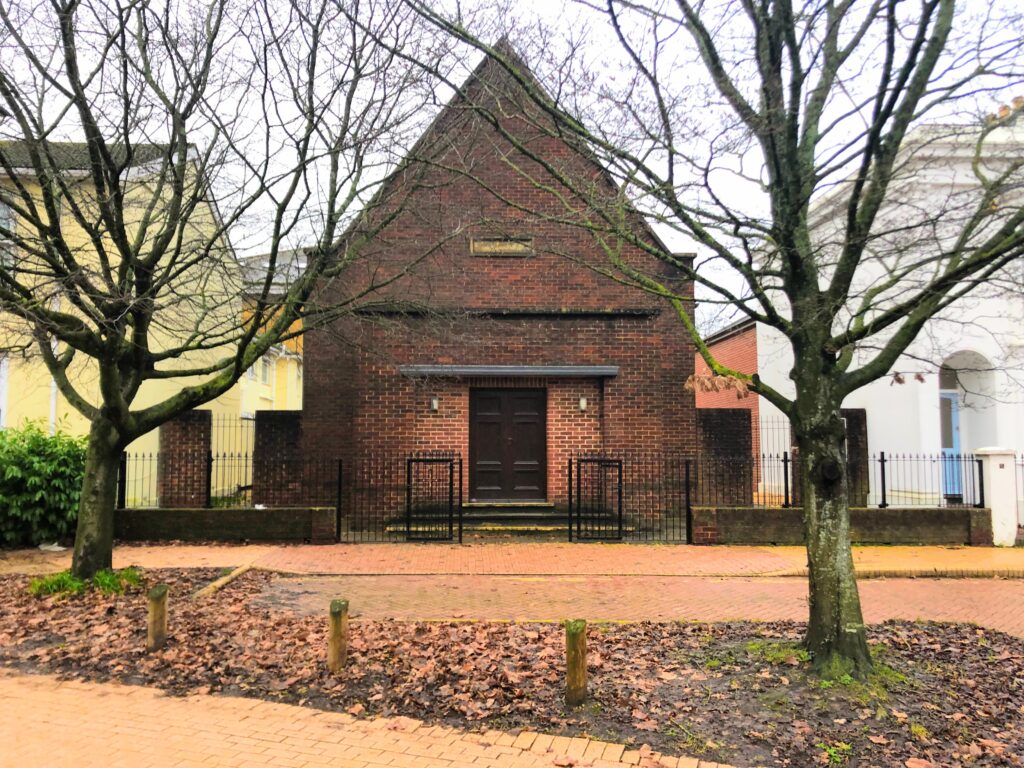
A member of the congregation named Mrs Mitchell kindly allowed the congregation (around 30) to meet in the sitting room of her house in Padwell Road. After she died three years later they met in a Mordaunt Hall in Mordaunt Road. The Methodist Chapel that owned the hall allowed this use for a rental of £40 a year. After 10 years however they asked for the hall back for their own use. During this period the church also made use of the baptistry at Bartley. The present chapel also named Bethesda was built in 1953 on the site of three terraced houses that had been fire-bombed with funds provided through the War Damages Commission amounting to £500. The opening services were held on 12th July 1953.
The Pastorate of Mr Leonard Broome
Mr Broome served as pastor at Bethesda from 1940 to 1986. His life and ministry is recorded in a book edited by his son called Surely Goodness and Mercy. Despite suffering discouragements in his initial years as pastor as he buried five members in four years, he also had many encouragements as his book testifies. From May 1945 to May 1951, he wrote the children’s exercises in the Little Gleaner magazine and later from July 1964 until the end of 1984, he edited the Friendly Companion. On May 7th 1979, the church celebrated the centenary of the church and the fortieth anniversary of Mr Broome as pastor. At this point, his health was in decline as he suffered from myeloma which grew progressively worse until his death in 1986. In these final years despite being in much pain he was able to baptise a further three persons as well as marrying a couple in July 1986. He preached his last sermon on 24th August 1986 passing away less than two weeks later on 6th September. His ministry was blessed and appreciated by many as is shown by the letters written to him. He said himself referring to those that had been converted under his ministry: ‘whilst one cannot count them on both hands, one can count a few’.
To the Present
Today Bethesda is much diminished in numbers but still seeks to uphold the doctrines adopted by the church in the late 19th century. While we would not despise the day of small things (Zechariah 4:10), we also believe that God is able to grant a great revival in this large city and to bring in seekers into faithful places of worship.